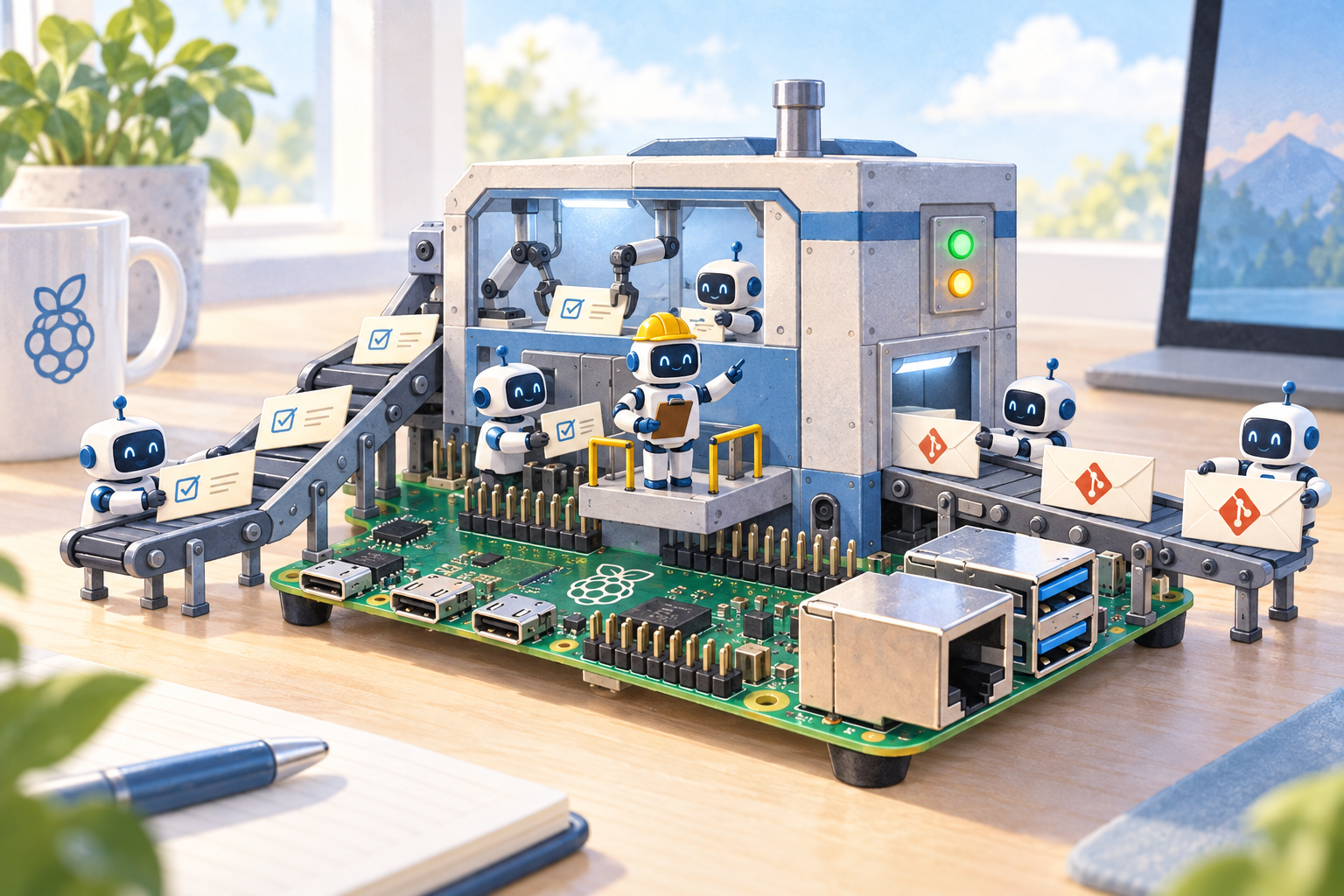
My side projects now run through a small software factory on a Raspberry Pi. Matt Pocock recently wrote that GitHub Actions are an easy way to start with software factories, before you build one on your own infra. I went straight to the second part, and it turns out a Pi is enough.
The ticket system is Forgejo, a self-hosted Git forge, running on a Pi 5 in my home network.
I write an issue. A small watcher service checks the issues every 30 seconds and wakes a Claude Code session that acts as the orchestrator.
It reads the issue (and rewrites it in much better style), starts worker sessions for the actual work, and they come back with a branch and a pull request.
Then the issue gets assigned to whoever has the next move. Usually that's me, with one sentence on what I should look at. I merge, and a Forgejo Action builds the docs.
The guardrails are boring on purpose. The agents run as their own Linux user without sudo or Docker. They can push branches, but only I can merge to main, and they only see the repos I hand over one by one.
A status page shows what the orchestrator is doing and which sessions are waiting for me.
What surprised me: I don't open a terminal for these projects anymore. I talk to the factory through issues, from whatever device is closest.
If you want to try this, start with Matt's version. Moving it onto a Pi took me one day of pairing with Claude, and Claude did the heavy lifting.
LinkedWild