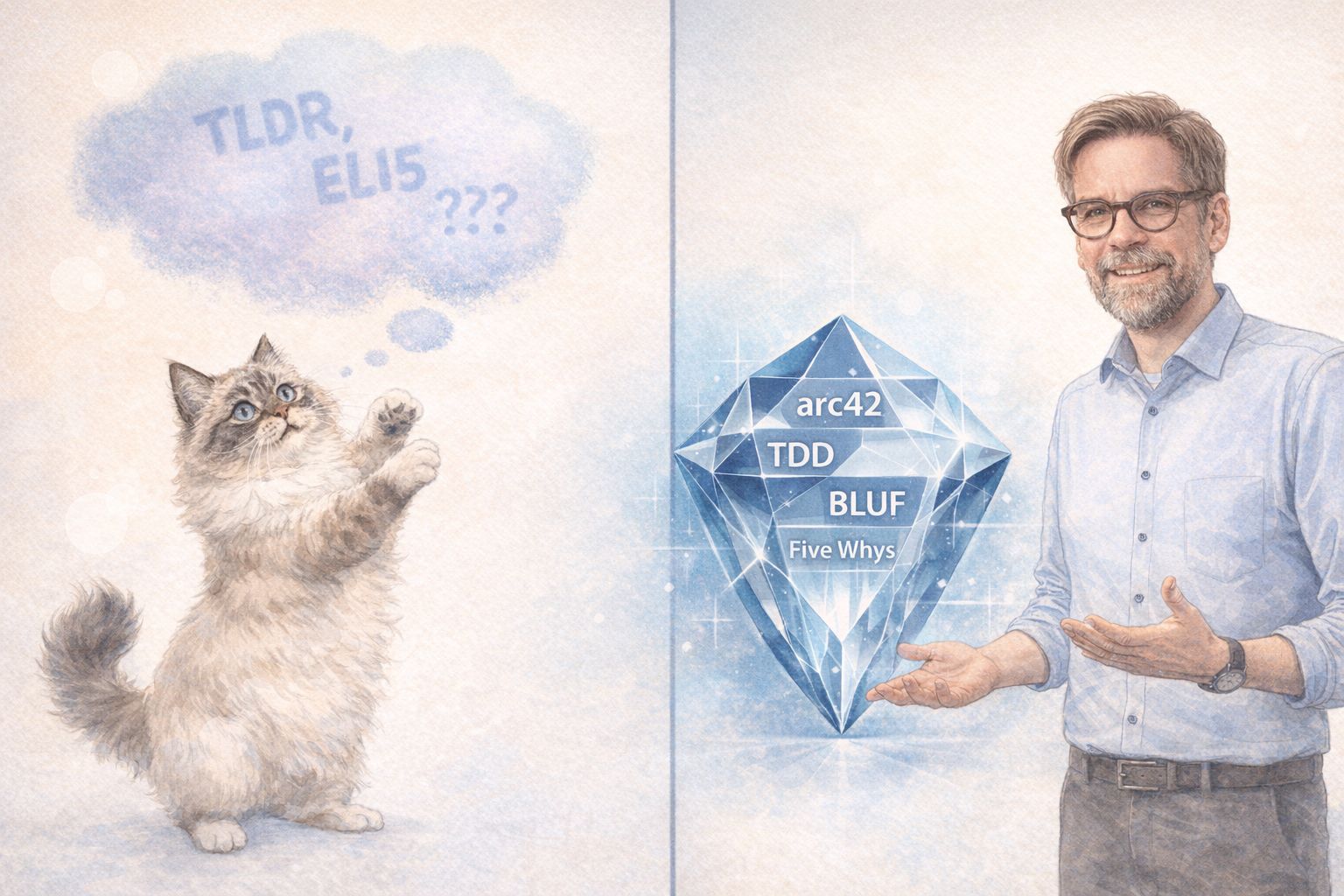
Is "TLDR" a Semantic Anchor? Why the answer matters for how you work with LLMs.
It started with a simple question: Does "TLDR" precisely define something when you use it in a prompt — or is it just vibes?
Turns out, this question cuts right to the heart of what makes LLM communication effective.
The Semantic Anchors catalog (github.com/LLM-Coding/Semantic-Anchors) collects well-defined terms that activate rich knowledge domains in LLMs — things like "TDD, London School", "arc42", or "Pyramid Principle according to Barbara Minto". Each of these terms compresses an entire methodology into a few words that an LLM can reliably unpack.
TLDR doesn't do that. It says "be short" — but not *how*, not *by what structure*, not *with what priorities*. It's underspecified. And that's the key distinction.
This led to a contribution that I think makes the catalog more useful:
→ Quality criteria that make explicit what qualifies as a semantic anchor: precision, richness, consistency, and attributability. With counter-examples showing why popular terms like TLDR or ELI5 don't make the cut.
→ A new category for Interaction & Reasoning Patterns — anchors that steer *how* an LLM collaborates with you, not just *what* it knows. Think "Socratic Method", "Rubber Duck Debugging", "Five Whys (Ohno)", or "Chain of Thought". These meet the same quality bar as domain anchors.
→ The insight that most anchors live on a spectrum — "Pyramid Principle" is both domain knowledge *and* a behavior instruction. The quality bar is the same across the spectrum. What matters isn't the category — it's the definition depth.
The practical takeaway: Next time you prompt an LLM, ask yourself — am I using a vague instruction ("keep it short") or a semantic anchor that activates a well-defined framework ("structure this using BLUF")?
The difference in output quality is remarkable.
Check out the catalog and consider contributing your own anchors: https://github.com/LLM-Coding/Semantic-Anchors
LinkedWild