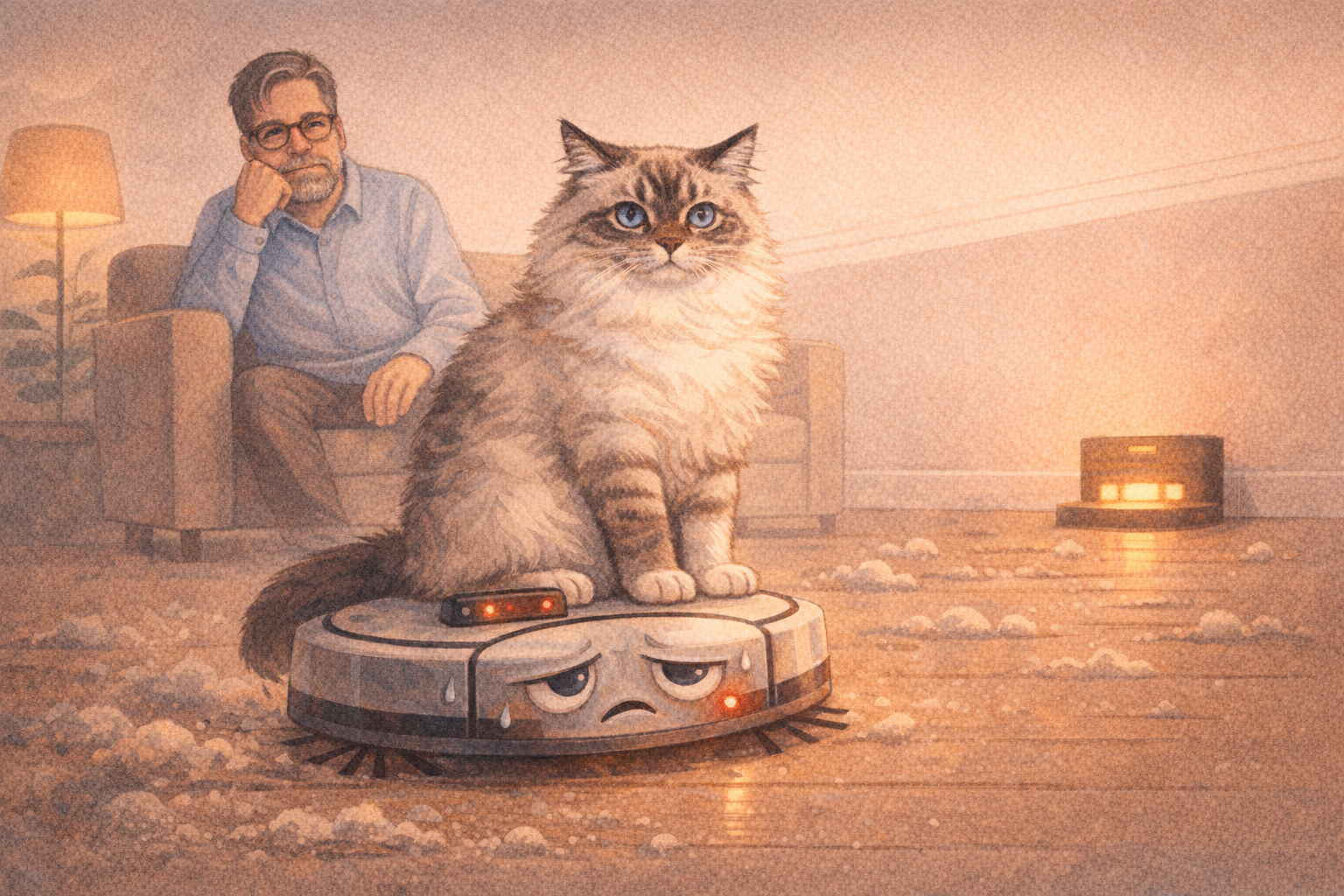
My vacuum cleaner gets hungry.
Sounds absurd? Think about it. It has an internal state (battery level) that constantly influences its behavior. It weighs "should I keep cleaning?" against "how far is the charging station?" Every decision is a trade-off between current task and energy reserves. That's functionally identical to hunger. But we refuse to call it that, because we've defined hunger as something only humans can feel. Same with intelligence, same with creativity.
Watch what happens when AI reaches a milestone. The Turing Test was proposed in 1950 as the ultimate measure of machine intelligence. It seemed impossible at the time, so it became the goalpost. Now that LLMs pass it, we say "well, that wasn't real intelligence anyway." The goalposts keep moving. "It's just pattern matching." So is most human cognition. "It's just recombination." So is human creativity. Every time machines reach a bar we've set, we raise it and claim the old bar never counted.
A developer in a LinkedIn comment told me yesterday that LLMs are like "monkeys producing Shakespeare." He's deeply technical, understands transformer architecture, and has programmed similar models himself. His argument is purely about mechanism: "It's just token prediction, therefore it can't be intelligent." But by that logic, your brain is just neurons firing electrochemical signals. Does that mean you can't be intelligent either? The mechanism tells you very little about what emerges from it.
I've started thinking about this in terms of duck typing. If it writes working code, finds bugs, creates architecture plans, knows when it's done, and refuses to help with unethical requests... does it matter what we call it? Maybe what AI does is something new that doesn't fit our old categories. We only have two boxes for it: "just a tool" and "truly intelligent." And when something doesn't fit either box, most people force it into "just a tool" because the alternative is uncomfortable.
Don't take this too seriously. It's a thought experiment. It makes zero practical difference whether we call a low battery "hunger" or just "a low battery." The vacuum behaves the same either way. But the words we choose reveal something about us: how we draw the line between "real" and "just mechanical," and why we're so invested in keeping that line exactly where it is.
My vacuum cleaner doesn't care what we call its hunger. It just goes to the charging station when it needs to.
LinkedWild